



Assessing and Repairing AC Condenser Damage After a Lawn Care Accident



When the Weed Whacker Strikes: Evaluating Outdoor Unit Damage
That sudden, loud clatter of a weed trimmer striking metal outside your window is enough to make any homeowner's stomach drop. If you are currently assessing and repairing AC condenser damage after a lawn care accident, you are likely looking at a panel of mangled metal and wondering if your cooling system is completely ruined. At Van Eddies Heating & Air Conditioning, our technicians see this surprisingly common, yet highly stressful, scenario across many Orlando FL residential properties. The immediate decision point is determining whether the damage is merely superficial or represents a critical structural failure.
While a large patch of bent fins looks terrible on the outside, the unseen damage to the copper refrigerant lines hidden underneath is the true threat to your comfort. A glancing blow from a mower deck or a flying rock can easily compromise the sealed system. This is exactly why evaluating outdoor unit damage requires a methodical, professional diagnostic approach rather than relying on a quick visual assessment by the homeowner. For comprehensive Air Conditioning Services, reaching out to a professional is the safest next step.
Immediate Actions to Protect Your HVAC System
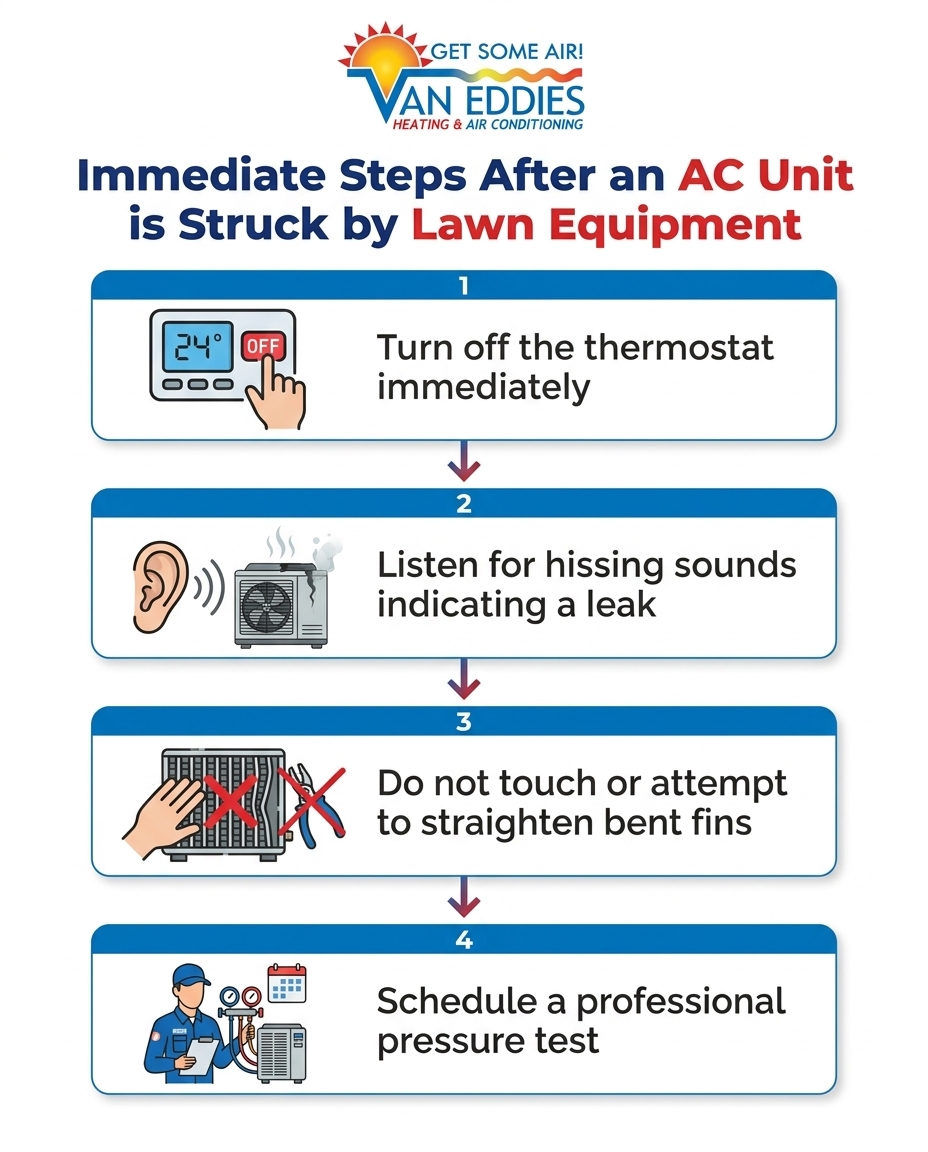
When you realize lawn equipment has struck the outdoor unit, taking immediate action can prevent a minor accident from escalating into a catastrophic compressor failure. Just last September, our team at Van Eddies helped a local homeowner who experienced a similar AC issue after an early-fall yard work incident; our technician arrived rapidly, diagnosed the issue with speed and accuracy, and made the necessary AC repair so the house was cool again the same day. To protect your system before the technician arrives, follow these crucial steps:
1. Turn off the thermostat immediately: Do not let the system continue to run. If the impact caused a refrigerant leak, the compressor will run dry. The compressor relies on the refrigerant to keep itself cool, and running without it leads to severe, irreversible internal damage.
2. Listen closely for hissing sounds: Stand near the outdoor unit and listen carefully. A hissing noise indicates a high-pressure refrigerant leak escaping from a punctured copper line. If you hear this, stay clear of the unit.
3. Keep grass clippings and landscaping debris away: Clear the immediate impact site of any loose debris, but do not push anything into the unit itself. Keeping the area clean helps the technician clearly see the impact zone upon arrival.
4. Avoid any DIY attempts to straighten fins: Do not touch the delicate aluminum fins or the copper coils underneath. Pushing on compromised metal can easily worsen existing micro-leaks or create entirely new punctures.
5. Schedule a professional assessment: Contact a licensed technician to evaluate the integrity of the system and perform a proper pressure test to confirm whether the sealed circuit has been breached.
Cosmetic Blemishes vs. Structural Threats: Anatomy of the Condenser
To understand what happens during a landscaping strike, you have to understand how the outdoor unit is built. Orlando's 10-to-12-month active growing season necessitates continuous lawn care, exposing outdoor units to these hazards nearly year-round. In our years of maintaining local HVAC systems, the Van Eddies team has seen units with a few dings and dents that still run perfectly, while others suffer complete failure from a seemingly minor bump. The difference lies in the anatomy of the condenser coil.
The delicate aluminum fins: These thin metal ridges line the outside of your condenser. Their primary job is to dissipate heat pulled from inside your home into the outdoor air. Because they must be incredibly thin to transfer heat efficiently, they bend easily upon impact. A weed whacker string can flatten hundreds of these fins in a fraction of a second.
The vital copper coils: Hidden just beneath those delicate fins is a network of pressurized copper tubing that carries the chemical refrigerant. This tubing is the absolute lifeblood of your cooling system. The fins are physically attached to these tubes to draw heat away from the hot refrigerant gas inside.
A large area of flattened aluminum fins might look disastrous, but it often does not affect the operation of the system significantly. The unit simply loses a tiny bit of heat-transfer surface area. However, a single pinhole puncture in the copper tube is a system emergency. Modern high-efficiency units are tightly packed with these components to maximize cooling power in a smaller footprint, making the vital copper lines highly vulnerable to flying debris like rocks thrown by a mower blade.
The Hidden Threat of Refrigerant Micro-Leaks
The most insidious result of a lawn care accident isn't the visible dent; it is the microscopic stress fracture in the copper tubing known as a micro-leak. When a piece of heavy equipment bumps the unit, or a rock strikes the metal at high speed, the impact sends a shockwave through the delicate coil structure. Even if the copper doesn't split wide open, the stress can create a tiny, almost invisible fracture.
Modern refrigerants, such as R-410A, operate under extremely high pressure—often exceeding 300 to 400 PSI on a hot afternoon. Because of this intense pressure, even the smallest pinhole puncture results in rapid fluid loss. As the refrigerant level drops, a destructive cascading effect begins inside the system. With less refrigerant to absorb heat, the pressure in the indoor evaporator coil drops drastically. The condensation on the indoor coil freezes into a solid block of ice, system efficiency plummets, and the compressor is forced to overwork until it eventually overheats and fails.
The tricky part is that a damaged system might still blow cool air for a few hours before the pressure drop shuts it down completely. This false sense of security leads many homeowners to ignore the accident, assuming that since the air is still cold, the unit is fine. The only definitive solution is having a professional inspect the unit immediately to catch the pressure drop before the compressor is permanently compromised.
Why Professional Pressure-Testing is Non-Negotiable
When it comes to verifying the health of your condenser after a strike, a simple visual inspection is never enough. You cannot reliably detect micro-leaks hidden behind layers of bent fins just by looking at them. The naked eye simply cannot spot a hairline fracture in a copper tube, especially when it is buried beneath mangled aluminum. This is where professional diagnostic tools come into play.
At Van Eddies Heating & Air Conditioning, our team emphasizes real-world emergency diagnostic speed and professional pressure-testing expertise to quickly resolve accidental damage panics. When one of our technicians arrives to perform an AC diagnostic test, they bring specialized equipment designed to evaluate the sealed refrigeration circuit with absolute certainty.
Isolating the lines: Technicians use specialized manifold gauges to monitor the pressure of the refrigerant inside the system. By measuring the standing pressure against the ambient temperature, they can confirm if the system is undercharged. A steady drop in pressure confirms that a leak exists, even if it cannot be seen.
Pinpointing the exact location: To find the precise source of the leak, professionals use electronic leak detectors that sniff out trace amounts of refrigerant gases in the air. As the sensitive wand passes over the dented area, it will beep rapidly if gas is escaping. In some cases, a UV dye is introduced into the system as a secondary confirmation method. Using a special blacklight, the technician can illuminate the exact spot where the copper is compromised.
Accurate diagnostics are critical because they prevent unnecessary full-unit replacements. By pinpointing the exact micro-leak, technicians can determine if a localized repair is possible or if the damage is too severe.
Brazing vs. Replacement: How Technicians Resolve Coil Damage
Once the technician locates the leak, the next step is determining the best path forward. Can the damaged condenser coil be repaired, or must it be replaced entirely? This decision depends heavily on the severity and location of the puncture.
Brazing is a specialized welding process used to seal a small puncture in a copper line. It requires extreme heat and precision to fuse a silver alloy over the hole without burning through the thin tubing. However, brazing is not always a viable option. If the damage is extensive, a full coil replacement is necessary. Remember, all refrigerant handling, recovery, and brazing must be performed by licensed professionals according to strict EPA regulations. Attempting this yourself is illegal, dangerous, and will void your warranty. Regular AC maintenance can help keep your system in top shape, but accidental damage requires immediate, specialized intervention.
• Brazing (Welding) — When It Applies: Single, accessible punctures on structurally sound copper tubes. — Long-Term Outlook: Excellent, provided the system is properly vacuumed and recharged afterward.
• Coil Replacement — When It Applies: Crushed lines, multiple impact points, or inaccessible internal leaks. — Long-Term Outlook: Restores factory efficiency, often required for older units where patching isn't viable.
When Brazing is the Right Choice
Brazing is generally the preferred route when the damage is highly localized. If a single rock flew out of a mower and struck one specific copper loop, a technician can often clean the area, apply the brazing torch, and seal the leak permanently. This is only possible if the overall coil remains structurally sound and the puncture point is easily accessible. Once the braze is complete, the technician will pressure-test the system with nitrogen to ensure the fix holds before safely restoring the system pressure with fresh refrigerant.
When Coil Replacement is Mandatory
Sometimes, the force of the impact is simply too great. If a riding mower backs into the unit, it can crush or severely crimp the copper lines. Crimped lines restrict the flow of refrigerant, acting like a kink in a garden hose, which destroys system efficiency and damages the compressor. Additionally, if there are multiple impact points across the unit, or if the unit is older and the metal is degraded, repairing is not cost-effective. In these scenarios, a full coil replacement is mandatory to restore safe operation. If your unit is older, this might also be the right time to consider a complete system upgrade, as installing a qualifying high-efficiency heat pump may make you eligible for federal tax credits or local utility incentive programs (always verify current programs with your utility provider or tax professional).
Safeguarding Your Condenser During Fall Yard Cleanups
The September early-fall yard transition is a prime time for landscaping accidents. As homeowners and lawn crews aggressively trim back overgrowth, aerate the soil, and prepare the yard for cooler months, the risk of heavy equipment striking the outdoor unit spikes significantly. To protect your investment, consider implementing these preventative measures before the next landscaping session.
• Establish a clear physical boundary: Install a small fence, a decorative stone border, or a trellis around the condenser. This creates a hard stop that keeps mowers and heavy equipment at a safe distance.
• Enforce a minimum clearance distance: Instruct your landscaping crews to maintain a minimum clearance distance of at least two to three feet from the unit when using weed trimmers or edgers.
• Clear the surrounding area: Keep the area immediately around the unit free of loose rocks, thick branches, pinecones, and debris that lawnmowers could easily turn into high-speed projectiles.
• Schedule regular system check-ups: Have our Orlando HVAC professionals at Van Eddies perform routine pre-heating-season inspections to catch any minor damage, loose panels, or flattened fins before they escalate into a major leak.
Restoring Your Peace of Mind and System Efficiency
A lawn care accident is undeniably stressful, but rapid professional assessment limits the long-term damage to your cooling system. By understanding how technicians differentiate between harmless cosmetic blemishes and critical structural leaks, you can make informed decisions about your equipment. Addressing the issue quickly, rather than waiting for the compressor to fail, ensures your home stays comfortable and your system operates efficiently. If your outdoor unit has suffered a recent strike, reach out to our local experts to evaluate the damage and explore your repair options today.
Frequently Asked Questions
Can a weed whacker cause a refrigerant leak?
Yes, a weed whacker can easily cause a refrigerant leak if the spinning line strikes the copper tubing inside the condenser. While the outer aluminum fins offer some protection, a direct or forceful hit can puncture the pressurized copper lines beneath them. Even a microscopic hole will allow refrigerant to escape rapidly, compromising the entire cooling system.
What should I do if a lawnmower hits my AC unit?
The very first step is to turn off your thermostat immediately to prevent the compressor from running without refrigerant. Next, go outside and listen carefully for any hissing sounds, which indicate a high-pressure leak. Do not attempt to touch or straighten the bent metal, and call a licensed HVAC technician for an emergency diagnostic evaluation.
How do technicians test for AC condenser damage?
Technicians use specialized manifold gauges to perform a pressure test on the sealed refrigeration circuit. By monitoring the pressure levels against ambient temperatures, they can determine if there is a hidden leak that a visual inspection missed. They may also use electronic leak detectors or UV dye to pinpoint the exact location of the puncture in the copper lines.
Will a dented AC unit still work?
A dented AC unit will often still work if the damage is strictly limited to the outer aluminum fins. The fins are designed to dissipate heat, and while flattening a few of them reduces efficiency slightly, it won't stop the system from cooling. However, if the impact dented or crimped the underlying copper coils, the unit is structurally compromised and requires professional repair.
How do you fix bent fins on an air conditioner?
Professionals fix bent fins using a specialized hand tool called a fin comb, which gently realigns the delicate aluminum ridges back into their proper spacing. Homeowners should never attempt to straighten fins with knives, screwdrivers, or bare hands, as this can easily puncture the pressurized copper tubing hidden underneath. If a large section of fins is flattened, it is best to leave the repair to a licensed technician during a routine maintenance visit.
Is it safe to run my AC if the outdoor coil is hissing?
No, it is absolutely not safe to run your AC if you hear a hissing sound coming from the outdoor coil. Hissing is a definitive sign of a severe, active refrigerant leak escaping under high pressure. Running the system in this state will quickly drain the refrigerant, causing the indoor coil to freeze and potentially destroying the expensive outdoor compressor.
Customer Testimonials


READY TO TRANSFORM YOUR HOMe?

Guide
Maintenance