

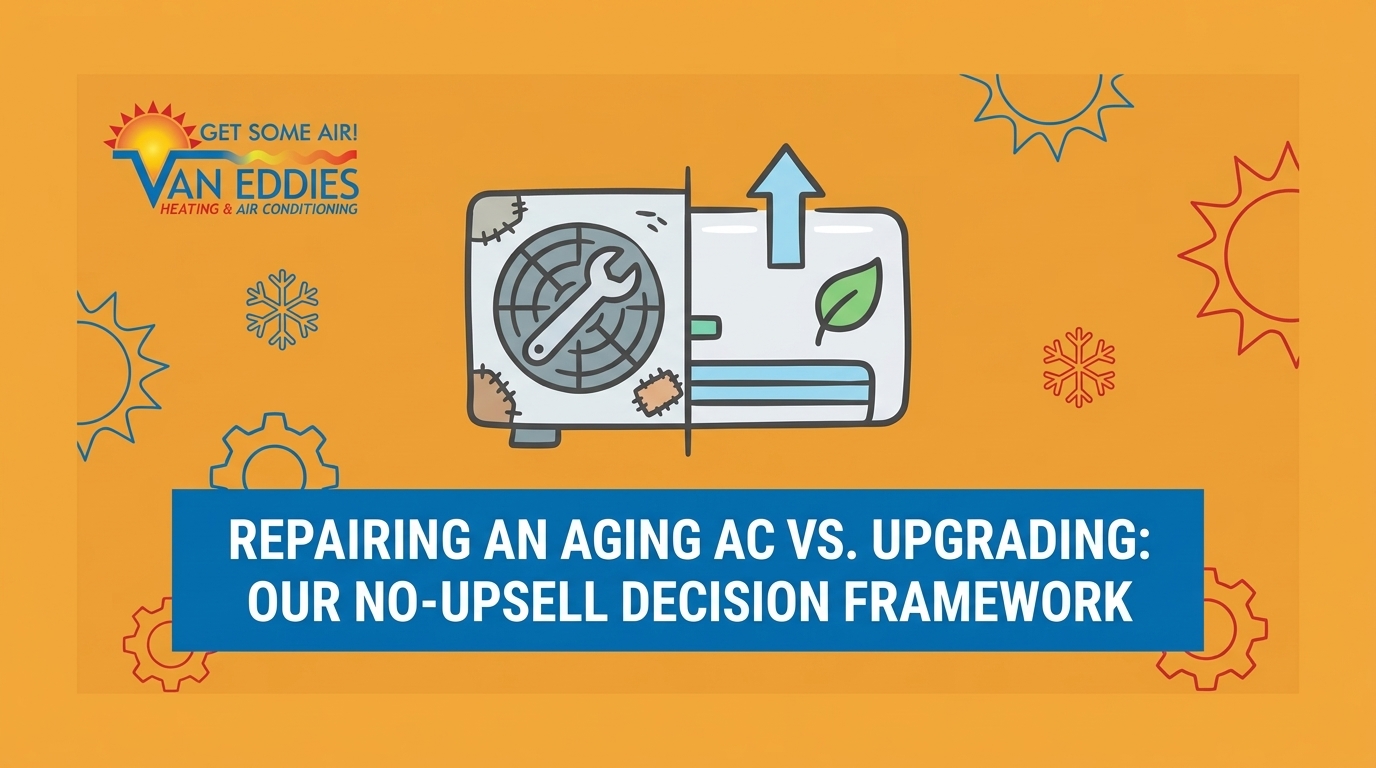
Repairing an Aging AC vs. Upgrading: Our No-Upsell Decision Framework



The Myth of the Mandatory AC Replacement
There is a persistent myth in the home service industry that the moment an older air conditioner starts struggling, it absolutely must be sent to the scrapyard. If you find yourself weighing the options between repairing an aging AC vs. upgrading: our no-upsell decision framework proves that a total replacement is not your only path forward. Many homeowners dread calling a technician for a struggling unit, fearing they will immediately face a high-pressure sales pitch for a brand-new system. This anxiety is especially common during the October fall maintenance window, when systems that barely survived the intense summer heat are evaluated for their winter resting phase.
The reality is that a struggling system is a mechanical problem, not a moral failing, and it requires an objective mathematical evaluation. Your air conditioning equipment is a significant investment, and deciding its fate should be based on concrete data, not scare tactics. By utilizing a clear, step-by-step evaluation method, you can find the smartest long-term financial choice for your specific household needs.
If you want to ensure your system gets a fair evaluation, our comprehensive air conditioning services are designed around honest diagnostics, not sales quotas.
How Extreme Florida Heat Accelerates AC Wear and Tear
To make an informed choice about your equipment, you first have to understand the environment it operates in. National averages often suggest that a central air conditioning system should last between fifteen and twenty years. However, those numbers are heavily skewed by data from milder climates where units sit idle for six months out of the year. In Orlando area homes, those national averages simply do not apply.
The Hidden Cost of Extreme Humidity
Florida's climate presents a unique challenge for mechanical cooling. Your air conditioner does not just lower the temperature of the air; it acts as a massive dehumidifier for your entire house. Excessive humidity forces your compressor into longer, more grueling runtime cycles. To properly extract moisture from the indoor air, the system has to run continuously, pushing the mechanical components to their absolute limits. This extended runtime accelerates the wear on moving parts, electrical contactors, and the compressor itself. A system in the Northeast might run for 800 hours a season, while a unit in Central Florida can easily double or triple that workload.
Compounding Stress from Deferred Maintenance
Because the cooling season in Florida lasts nearly year-round, there is very little downtime for the equipment. If routine maintenance is skipped or deferred over multiple harsh summers, the strain compounds rapidly. A dirty condenser coil forces the system to run hotter and harder to dissipate heat. A clogged air filter restricts airflow, causing the blower motor to draw more amperage. Over time, these small inefficiencies add up, accelerating the aging process and shifting the mathematics of the repair-versus-replace conversation much earlier than a homeowner might expect.
When Repairing Your Current System is the Smartest Choice
An honest technician will always celebrate a simple, effective fix rather than pushing an unnecessary upgrade. There are many scenarios where repairing your existing equipment is genuinely the most logical and cost-effective route. An isolated failure during peak heat does not automatically mean the whole system is collapsing.
For instance, one homeowner experienced an indoor unit fan motor failure on a Saturday afternoon during unbearable summer heat. Instead of pushing a total system replacement, the technician troubleshot the issue over the phone, arrived with a working motor, and had the AC fully up and running smoothly again. This is the exact outcome a trusted professional aims for.
Here are the primary scenarios where an AC repair makes the most sense:
1. The system is under ten years old: Units in this age bracket usually still have plenty of functional life left. Unless the compressor has catastrophically failed, repairing a younger system is almost always the right move.
2. The breakdown is isolated: If a single component—such as a dual run capacitor, a contactor, or a fan motor—fails, replacing that specific part restores the system to full functionality without requiring a massive investment.
3. The unit has been well-maintained: A system that has received regular tune-ups, filter changes, and coil cleanings is a prime candidate for repair. Consistent upkeep preserves the core components, meaning a minor breakdown is likely just normal wear and tear rather than a symptom of systemic failure.
4. The system uses current refrigerant: If your unit operates on modern, readily available refrigerants (like R-410A), recharging the system after repairing a minor leak remains a viable and standard procedure.
Inside Our Transparent, No-Upsell Diagnostic Process
Understanding how your system is evaluated can remove the stress from the service call. Our transparent, no-upsell evaluation process ensures homeowners receive honest cost-benefit analyses instead of fear-based ultimatums. We believe in pulling back the curtain on the diagnostic steps so you can see exactly how the health of your system is determined.
The Problem: Fear-Based Sales Tactics
A typical pattern we see in the industry is the "condemn and replace" approach. A technician arrives, notes the age of the unit, finds one broken component, and immediately declares the entire system unsafe or unfixable. This leaves the homeowner feeling cornered, forced to make a major financial decision under extreme duress.
The Cause: Lack of Objective Data Collection
This high-pressure environment thrives on a lack of transparency. If the homeowner does not understand what is actually broken, they have to take the salesperson's word for it. Without testing the electrical draw, checking the subcooling and superheat levels, or inspecting the physical condition of the coils, any recommendation is just a guess—or worse, a targeted sales pitch.
The Solution: Our Data-Driven Evaluation
We approach every service call during the October fall maintenance window—and throughout the year—as an opportunity to gather data. A thorough diagnostic involves testing the electrical components with a multimeter to check for voltage drops and proper amperage. We check the refrigerant levels using digital manifold gauges to assess the exact health of the cooling cycle. We inspect the compressor for signs of overheating or hard starting. The goal is to provide you with the exact mathematical reality of your system's condition. If you want to know more about this thorough process, you can review how much time is needed for an AC diagnostic test to see exactly what we check and why it matters.
When an AC Upgrade Becomes the Better Investment
While we prioritize repairs whenever possible, there comes a point where pouring money into an aging machine becomes a poor investment. A fast fix is always the initial goal. For example, when another home air conditioning system stopped working properly during an urgent cooling crisis, the issue was diagnosed with speed and accuracy, quick repairs were made, and the house was cool again the same day. However, if that same accurate diagnosis reveals a massive, systemic failure on an outdated unit, the conversation has to shift toward replacement.
Recognizing the Tipping Point
The concept of diminished returns is crucial here. If your system is over ten to twelve years old in the Florida climate, its efficiency has likely dropped significantly from when it was new. If it faces a catastrophic failure—such as a dead compressor or a severely leaking evaporator coil—the cost of the repair often outweighs the remaining value of the unit.
The Obsolete Refrigerant Factor
One of the most definitive signs that an upgrade is necessary is the type of refrigerant your system uses. Older units running on R-22 (often known as Freon) face a unique challenge. Because R-22 has been entirely phased out of production due to environmental regulations, the remaining supplies are strictly limited. If an R-22 system develops a significant leak, repairing and recharging it is often financially impractical. In these cases, moving forward with an AC replacement is the only logical step.
Long-Term Benefits of High-Efficiency Systems
Choosing to upgrade brings immediate benefits that offset the initial investment. Modern, high-efficiency systems offer vastly improved comfort, superior humidity control, and significantly lower monthly energy usage. Variable-speed compressors can run at lower capacities for longer periods, quietly extracting humidity without freezing you out of the room. Furthermore, generic energy rebates, federal tax credits, or local utility incentives may be available for qualifying high-efficiency installations, making the transition even more viable for Orlando area homes.
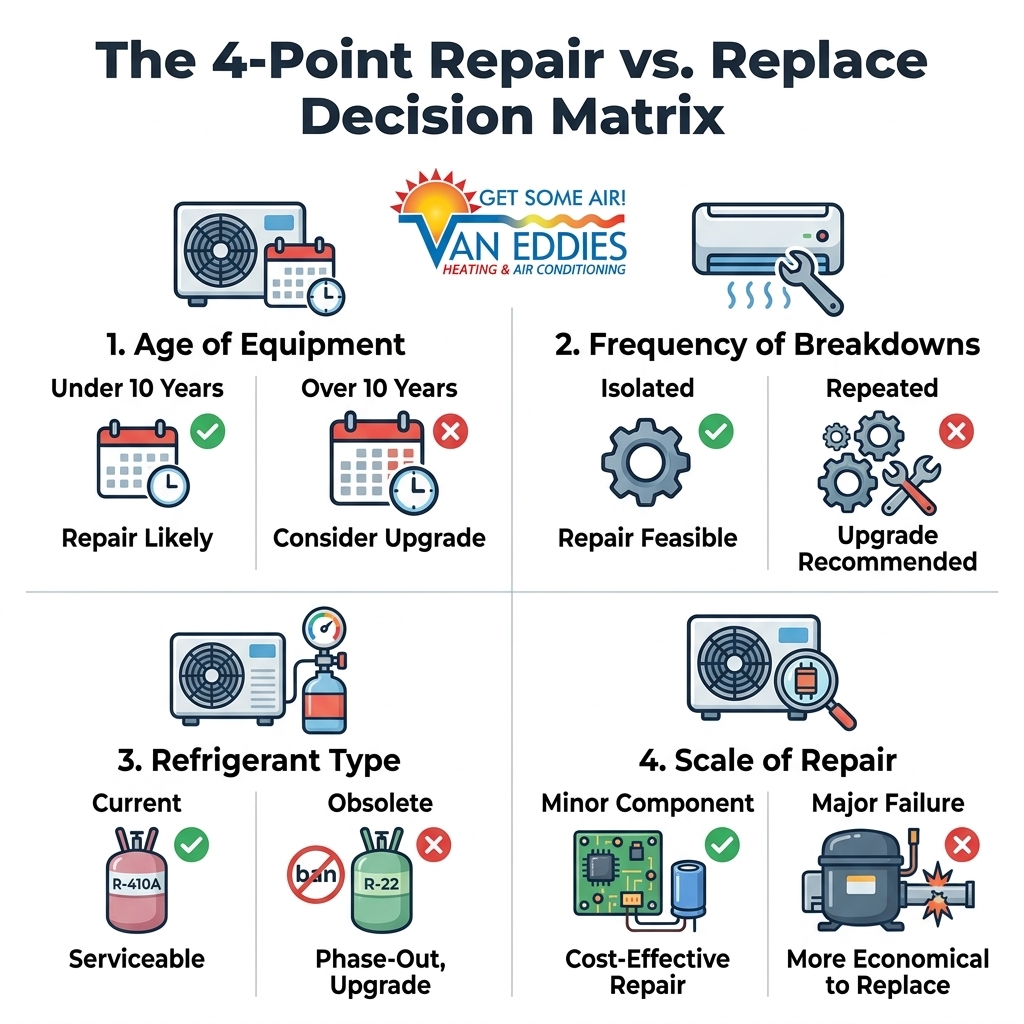
The 4-Point Repair vs. Replace Decision Matrix
To help you organize your thoughts and evaluate your own situation objectively, we use a simple, scannable framework. This matrix removes the emotion from the decision and focuses entirely on the mechanical and financial realities of your equipment.
• Age of Equipment — Leans Toward Repair: Under 10 years old — Leans Toward Replace: Over 10-12 years old (in Florida)
• Frequency of Breakdowns — Leans Toward Repair: First major issue / rare problems — Leans Toward Replace: Multiple service calls in a single year
• Refrigerant Type & Efficiency — Leans Toward Repair: Uses current R-410A / moderate energy bills — Leans Toward Replace: Uses obsolete R-22 / massive energy waste
• Scale of Repair — Leans Toward Repair: Minor components (capacitors, fans, contactors) — Leans Toward Replace: Major components (compressor, coils, reversing valve)
1. Age of Equipment
Age is the first filter. As discussed, the intense Florida climate accelerates wear. If your unit is under a decade old, it was built with relatively modern efficiency standards and should be preserved. Once a system crosses the 12-year mark in our region, it is officially entering its twilight years, and any major investment in it should be heavily scrutinized.
2. Frequency of Breakdowns
A reliable system should run quietly in the background of your life. If this is the first time you have had to call a technician in five years, a repair is highly recommended. Conversely, if you are on a first-name basis with your repair technician because the system breaks down every few months, you are experiencing the "nickel and dime" effect. Those repeated repair bills would be better applied to a new, warrantied system.
3. Refrigerant Type and Efficiency
The type of blood pumping through your system matters. Current refrigerants are standard and manageable. Obsolete refrigerants turn a minor leak into a major financial hurdle. Additionally, if your energy bills have been steadily climbing year over year despite normal usage, your aging system is wasting electricity to produce the same amount of cooling.
4. Scale of Repair
Not all broken parts are created equal. Electrical components like capacitors and contactors are designed to be replaced periodically—they are the brake pads of your air conditioner. The compressor, however, is the engine. If the engine dies on an old, high-mileage vehicle, replacing it is rarely the smart choice.
Protecting Your Comfort Regardless of Your Choice
Whether you decide to breathe new life into your current older unit or invest in a brand-new, high-efficiency upgrade, the journey does not end on the day of the service call. Mechanical systems require ongoing attention to perform reliably in our demanding climate.
If you choose to repair an older unit, strict upkeep is absolutely vital to prevent the next breakdown. An aging system has less tolerance for neglect; a dirty filter that a new system might push through could be the exact thing that causes an older blower motor to finally burn out. Proactive care is your best defense against unexpected mid-summer emergencies.
Even if you opt for a brand-new installation, routine care remains essential. Modern systems are highly advanced, utilizing precise sensors and variable-speed technology. To keep these sophisticated components running at peak efficiency—and to maintain the manufacturer's warranty—regular professional tune-ups are required. Establishing a relationship with a trusted local provider through a routine maintenance plan ensures that your home remains comfortable, efficient, and protected year after year, especially as you prepare during the October fall maintenance window.
Frequently Asked Questions
When is it not worth repairing an AC?
It is generally not worth repairing an AC when the cost of the repair approaches fifty percent of the value of a new system. This usually happens when a major component, like the compressor or evaporator coil, fails on a unit that is over ten years old. Additionally, if the system uses obsolete R-22 refrigerant and has developed a leak, the expense of recharging it makes repairing it financially impractical. At that point, investing in a new system provides better long-term value.
How long do AC units last in Florida?
In Florida, a central air conditioning unit typically lasts between ten and fifteen years. This is shorter than the national average because the extreme heat and high humidity force the system to run for significantly more hours each year. Coastal salt air and near year-round operation accelerate the wear and tear on mechanical components. Regular, professional maintenance is the most effective way to help a system reach the higher end of that lifespan.
Is it better to repair or replace a 10-year-old AC?
The decision to repair or replace a ten-year-old AC depends heavily on the scale of the breakdown and the system's repair history. If the issue is a minor, inexpensive electrical component and the unit has been well-maintained, a repair is usually the better choice. However, if the system requires a major repair, has been breaking down frequently, or struggles to keep the house cool, replacing it with a modern, high-efficiency unit is often the smarter investment.
What is the rule of thumb for replacing an air conditioner?
A common industry guideline is the "$5,000 rule" or the "age-times-repair-cost" formula, where you multiply the age of the equipment by the estimated cost of the repair. If the resulting number exceeds a certain threshold, replacement is recommended. More simply, if the unit is past its warranty period, requires frequent service calls, and the current repair is extensive, the rule of thumb suggests upgrading to stop the cycle of endless repair bills.
Do generic energy rebates make replacing an AC more viable?
Yes, generic energy rebates, utility incentives, and federal tax credits can significantly improve the financial viability of replacing an older AC. These programs are designed to encourage homeowners to upgrade to high-efficiency systems that consume less power. While specific programs and qualifications vary by location and equipment type, these incentives can help offset the initial investment, making a new installation much more attractive than pouring money into an aging unit.
How does extreme humidity affect my AC's lifespan?
Extreme humidity forces your air conditioner to work twice as hard, acting as both a cooling system and a whole-house dehumidifier. To pull moisture out of the thick indoor air, the compressor has to run in longer, continuous cycles. This constant operation prevents the system from resting, accelerating the mechanical degradation of moving parts and ultimately shortening the overall lifespan of the equipment compared to units in drier climates.
Making the Right Choice for Your Home
Navigating an HVAC failure doesn't have to be a stressful, high-pressure experience. By relying on objective data rather than sales tactics, you can confidently choose the path that makes the most sense for your household. Whether repairing an aging AC vs. upgrading: our no-upsell decision framework is built to provide you with a clear, objective set of criteria to help you make a confident decision without feeling pressured by a salesperson.
Customer Testimonials


READY TO TRANSFORM YOUR HOMe?