



Why Pressing the Outdoor Goodman Condenser Reset Button Isn't Fixing Your AC



Why Does My Goodman AC Keep Tripping the Reset Button?
If you find yourself constantly walking outside to restart your system, you are probably wondering why pressing the outdoor Goodman condenser reset button isn't fixing your AC. It is an incredibly frustrating cycle. The September late-summer lingering heat and humidity in Orlando is brutal, and a working air conditioner is a necessity, not a luxury. You find that red reset button on your outside unit, push it in, and hear the comforting hum of the compressor kicking back on. Cold air starts flowing from your vents, giving you temporary relief. But an hour later, the house feels warm again, and the system has shut completely down.
When your system is trapped in this cycle, it is time to stop pushing buttons and look into professional air conditioning services or schedule an expert professional AC repair.
At Van Eddies Heating & Air Conditioning, the biggest misconception we see Orlando homeowners make is assuming that the reset button is a magical fix. It is not. That button is a critical safety mechanism designed to protect your equipment. A repeatedly tripping outside AC reset button is a giant red flag. It means the system is masking a deeper, potentially dangerous high-pressure issue that requires professional diagnostics. Every time you push that button, you are forcing the system to ignore its own safety alarms, which can turn a minor repair into a catastrophic breakdown.
Understanding the High-Pressure Safety Switch on Your Condenser
Many homeowners misunderstand what that little red button actually does. Our team frequently explains to customers that it is not a standard troubleshooting step like rebooting a frozen computer or resetting a household internet router. On Goodman outdoor condenser units, this reset button is directly tied to the high-pressure safety switch.
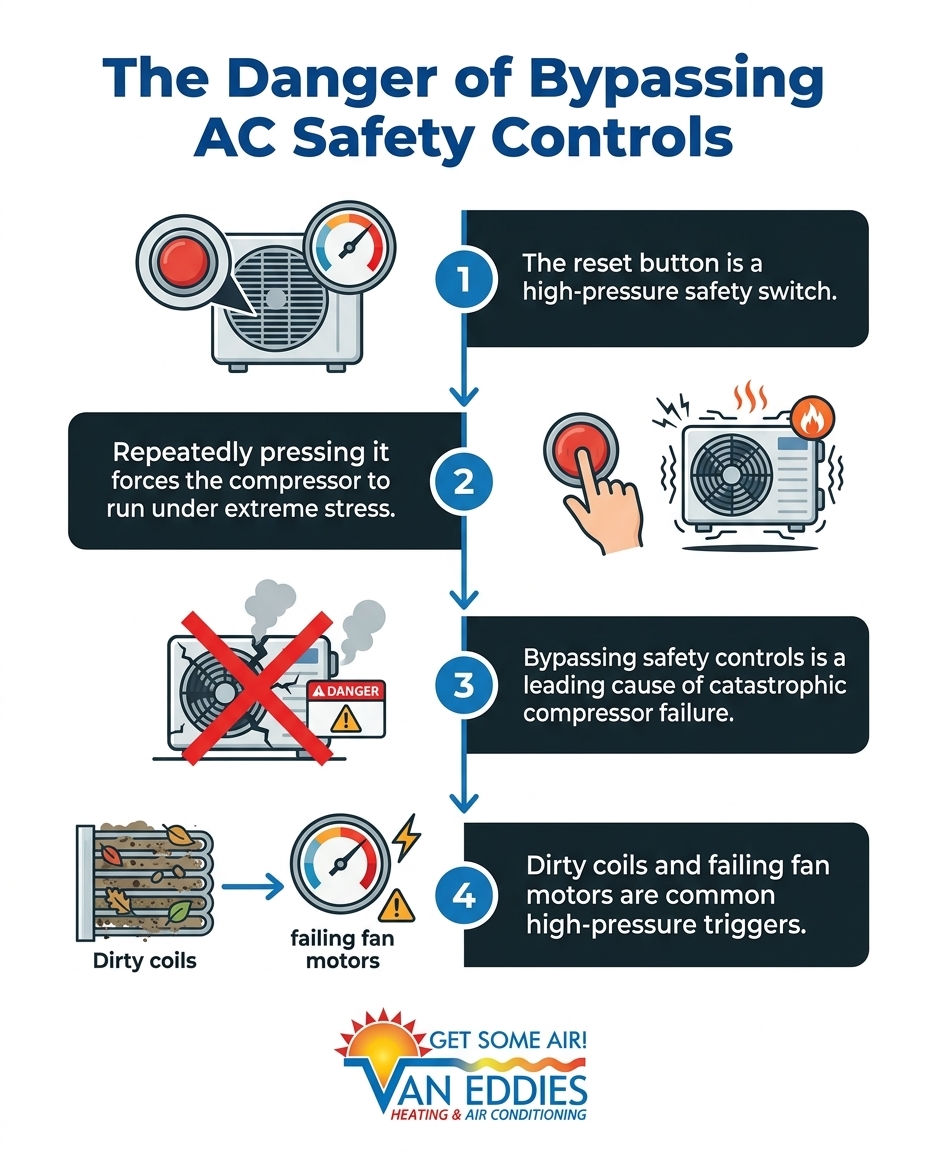
The high-pressure safety switch is a protective mechanism that constantly monitors the refrigerant pressure inside your air conditioner. If the pressure spikes beyond safe operating limits, the switch immediately cuts power to the compressor to prevent catastrophic mechanical failure.
There is a big difference between a one-time trip and a chronic issue. Sometimes, a random power surge or a brief electrical anomaly in the neighborhood grid can cause a nuisance trip. In those rare cases, knowing how to properly reset your Goodman air conditioner safely is helpful. But if you have to press it twice in one week—or twice in one day—you are no longer dealing with a fluke. You are dealing with a severe pressure fault that the system cannot resolve on its own.
What Happens When the Switch Trips?
When the internal refrigerant pressure exceeds the manufacturer's safety threshold, the switch physically opens the electrical circuit. Power is immediately severed to the compressor, halting all cooling operations instantly. In many models, the outdoor fan will also stop spinning. This is an intentional design to prevent any further heat accumulation inside the unit. The system goes into a hard lockout, refusing to run until it is manually reset. This hard lockout is the only thing standing between your current AC issue and a completely destroyed compressor.
The Hidden Dangers of Repeatedly Bypassing Safety Controls
Every time you press that reset button, you are forcing the system to ignore its own safety alarms. This is one of the most dangerous things you can do to your HVAC equipment. Forcing the compressor to run under extreme high-pressure conditions causes severe mechanical stress.
The compressor is the heart of your air conditioning system. It acts as a massive pump, pushing refrigerant through the lines to absorb heat from inside your home and release it outside. When pressure builds up with nowhere to go, the compressor motor has to work twice as hard to move that fluid. It quickly overheats, the internal wiring degrades, and the internal mechanical parts begin to grind together without proper lubrication. Bypassing safety controls is a leading cause of premature compressor burnout and complete system failure.
Just last early fall, our team responded to a local homeowner who experienced a sudden home AC issue with an urgent need for cooling during a September heatwave. Instead of repeatedly resetting the system and risking the compressor, they left the unit off and called us for help. Our technician responded, diagnosed the underlying high-pressure issue with speed and accuracy, and made the necessary repair. Because they didn't force the system to keep running while compromised, the house was cool again the same day without needing major, costly component replacements.
• One-Time Reset — System Impact: Clears a temporary electrical fluke or nuisance trip. — Long-Term Result: System resumes normal, safe operation.
• Repeated Resets — System Impact: Forces compressor to pump against extreme resistance. — Long-Term Result: Overheating, internal mechanical damage, and eventual burnout.
• Leaving Unit Off — System Impact: Prevents further damage while awaiting diagnostics. — Long-Term Result: Preserves the compressor and allows for a targeted repair.
Common Triggers for High-Pressure Lockouts in Early Fall
Why does a repeatedly tripping outside AC reset button happen so often in early fall? In our years of maintaining Orlando HVAC systems, we've found the answer lies in the accumulated wear and tear of the heavy cooling season. Orlando's humid subtropical climate accelerates outdoor coil fouling from biological growth and debris. When you combine that with the September late-summer lingering heat and humidity, it pushes already-strained systems right over the edge.
1. Dirty Condenser Coils: Over the summer, your outdoor unit sucks in lawn clippings, dirt, and debris. In a humid climate, biological growth also clings to the aluminum fins. This thick blanket of grime traps heat inside the unit, preventing it from escaping into the outside air.
2. Failing Condenser Fan Motor: The large fan on top of your outdoor unit is responsible for blowing hot air away from the compressor. If the motor is wearing out, the capacitor is failing, or the blades are damaged, it struggles to dissipate heat, causing internal pressure to spike rapidly.
3. Refrigerant Flow Restrictions: A clogged filter drier or a malfunctioning thermal expansion valve can trap refrigerant in the outdoor unit. This creates a severe physical bottleneck, driving up pressure until the safety switch trips.
4. Overcharged Refrigerant: If an inexperienced person recently added refrigerant to your system without measuring the subcooling and superheat properly, there might be too much fluid in the lines. Excess refrigerant leaves no room for expansion, leading to immediate high-pressure lockouts on warm days.
Routine AC maintenance prevents these end-of-season breakdowns by keeping coils completely clean, monitoring refrigerant levels, and ensuring motors are running smoothly before the transition to cooler weather begins.
The Role of Heat Rejection
Air conditioning units do not actually "create" cold air. They absorb heat from the air inside your home and carry it outside to release it. This process is called heat rejection. If the outdoor unit cannot release that heat because of dirty coils or a bad fan, the heat stays trapped inside the system. As the internal temperature rises, the refrigerant pressure rises along with it. When that pressure hits the danger zone, the switch trips.
Root Cause Diagnostics vs. Temporary Band-Aids
Pressing a button is a temporary band-aid. It does absolutely nothing to solve the underlying problem. To permanently fix a tripping high-pressure switch on Goodman outdoor condenser units, you need root cause diagnostics.
Licensed technicians do not just guess at the problem. They use specialized manifold gauges to measure the exact refrigerant pressures on both the high and low sides of the system. They use digital multimeters to check the electrical draw of the compressor and the outdoor fan motor. They use temperature probes to measure how effectively the coils are rejecting heat. This hard data tells them exactly why the system is overheating and locking out.
At Van Eddies Heating & Air Conditioning, our technicians are committed to thorough, professional diagnostics that fix the root cause of the problem. We believe in honest repairs that restore your system's reliability, rather than just applying quick fixes that leave you stranded again next week. As we always remind our customers, high-pressure refrigerant diagnostics are strictly for licensed professionals, as working with compressed gases and high-voltage electricity requires extensive training and specialized safety equipment.
Speed and accuracy matter when your system is locked out in the heat. When another customer's AC system stopped working recently, they had an urgent repair need. One of our technicians arrived within an hour, bypassed the guesswork, tested the electrical components, and fixed the AC. The system was working within 20 minutes of the technician's arrival because they knew exactly how to trace the high-pressure fault to its true source.
When to Stop Resetting and Call a Professional
If you are dealing with a repeatedly tripping outside AC reset button, you need clear guidelines on when to step back. In our professional experience, continuing to push the system will only lead to a burnt-out compressor and a much larger repair bill.
• Follow our rule of thumb: If the system trips a second time after you perform a proper reset, leave it off completely. Do not try a third time. The system is actively trying to tell you it is in danger.
• Shut off the power: Turn the thermostat to the "Off" position inside your house. Then, go to your main electrical panel and flip the breaker for the AC unit to the "Off" position. This completely severs power and protects the equipment from short-cycling or electrical damage.
• Document the symptoms: Write down exactly what happened before the system tripped. Did you hear strange grinding or buzzing noises? Was the air coming from the vents lukewarm instead of cold? Did the outdoor fan stop spinning while the compressor kept humming? This information is incredibly valuable to your technician.
• Call in the experts: Contact local AC technicians in Orlando—like our dedicated team at Van Eddies—who understand how our regional climate stresses HVAC systems and can accurately diagnose the high-pressure fault.
FAQ
Why does my Goodman AC keep tripping the reset button?
Your Goodman AC keeps tripping the reset button because the high-pressure safety switch is detecting dangerously high refrigerant pressure. This is not a glitch; it is a protective mechanism doing its job to save your compressor. Common causes include severely dirty condenser coils, a failing outdoor fan motor, or a physical restriction in the refrigerant lines. Repeated tripping means the root cause has not been resolved and requires professional diagnostics.
Where is the reset button on a Goodman AC unit located?
The reset button on a Goodman outdoor AC unit is typically located near the bottom of the condenser, protruding from the high-pressure switch on the copper refrigerant lines. It is usually a small, red, rubber-coated button. You will often find it near the service valve where the copper pipes enter the outdoor cabinet. If you cannot locate it easily, it is best to consult your owner's manual or call a professional for guidance.
Is it safe to keep pressing the reset button on my AC?
No, it is never safe to repeatedly press the reset button on your air conditioner. The button is a safety lockout designed to prevent catastrophic damage to the system. By constantly resetting it, you force the compressor to run under extreme physical stress. This masks the underlying problem and almost always leads to permanent compressor failure.
How many times can I press the AC reset button before causing damage?
You should only press the AC reset button once to see if a minor power fluctuation caused a temporary nuisance trip. If the unit trips a second time, damage is already a significant risk if you continue. There is no safe number of repeated resets. Forcing the system to run while the high-pressure switch is actively trying to shut it down will eventually burn out the compressor motor.
What causes a high-pressure switch to trip on an air conditioner?
A high-pressure switch trips when the system cannot properly release heat, causing the internal refrigerant pressure to spike rapidly. This lack of heat rejection is usually caused by severely dirty condenser coils, a broken outdoor fan, or overcharged refrigerant. When the heat gets trapped inside the outdoor unit, the pressure builds until the safety switch cuts the power to prevent an explosion or motor burnout.
Can a dirty air filter cause the outdoor reset button to trip?
While a dirty air filter usually causes low-pressure issues and frozen indoor coils, it can occasionally contribute to overall system overheating. A clogged filter severely restricts airflow through the entire system. Although high-pressure trips at the outdoor unit are much more commonly caused by dirty outdoor coils or fan failures, severe indoor airflow restrictions throw the entire refrigeration cycle out of balance, putting extra strain on the compressor.
Time to Fix the Root Cause
A repeatedly tripping outside AC reset button is a warning sign you simply cannot ignore. While it is tempting to keep pressing it for a few minutes of cold air, doing so puts your entire compressor at risk of permanent failure. If your high-pressure safety switch keeps locking you out, leave the power off and schedule professional diagnostics to fix the root cause and restore your comfort safely.
Customer Testimonials


READY TO TRANSFORM YOUR HOMe?

Guide